
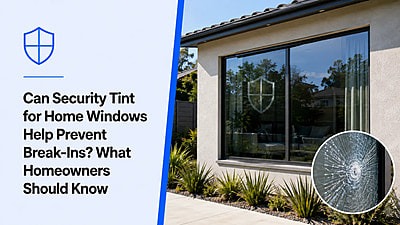
Windows and sliding glass doors are among the most vulnerable access points in a home. Standard residential glass can break quickly when struck, potentially allowing an intruder to reach a lock or create an opening.
Security tint for home windows can make that process more difficult by helping broken glass remain together after impact. Instead of immediately falling out of the frame, the fractured pane may stay bonded to the film, forcing an intruder to spend more time and effort creating an opening.
However, security film cannot guarantee that a break-in will be prevented. It should be viewed as a delay and glass-retention measure—not as an indestructible barrier or replacement for locks, alarms, cameras, and other home-security systems.
What Is Security Tint for Home Windows?
“Security tint” is a common name for residential safety and security window film. It is made from strong polyester layers and an adhesive system designed to bond the film to the glass.
Unlike standard residential tint, which is primarily installed for heat reduction, glare control, UV protection, or privacy, security film is engineered to help hold shattered glass together.
Clear, tinted, and solar-control security films are available. This allows homeowners to add protection without necessarily making their windows dark or reflective.
Professional residential security window film may be installed on:
- Ground-floor windows
- Sliding glass doors
- Patio doors
- Glass entry doors
- Door sidelights
- Basement windows
- Garage windows
- Secluded side and rear windows
- Large picture windows
How Can Security Window Film Delay a Break-In?
An intruder attempting to enter through untreated glass may strike the window, remove loose fragments, and reach through the opening.
Security film changes how the glass behaves after it breaks. The adhesive bonds the fractured pieces to the film, helping the damaged pane remain together. An intruder may need to strike the glass repeatedly, tear through the film, or force the filmed pane away from its frame.
That delay can provide valuable time for:
- The intruder to abandon the attempt
- An alarm to activate
- Occupants to move to a safer location
- Neighbors to notice suspicious activity
- Security personnel or law enforcement to respond
The film does not make the window impossible to penetrate. Given enough time, force, and tools, a determined intruder may still get through.
Why the Window Frame and Attachment System Matter
The film is only one part of the protective system. Overall performance depends on:
- The type and condition of the glass
- Film construction and thickness
- Adhesive strength
- Installation quality
- Window-frame strength
- Existing locks and hardware
- Whether the film is attached to the frame
If security film is applied only to the glass, the broken pane may remain together but separate from the frame under sufficient force. An edge-attachment system is designed to connect the filmed glass more securely to the frame.
Not every home or window requires the same attachment method. A professional installer should inspect the glass, frame, and risk level before recommending a system.
Security Film vs. Standard Residential Window Tint
Security film and standard tint can look similar, but their primary functions are different.
| Feature | Security Window Film | Standard Window Tint |
| Primary purpose | Glass retention and added protection | Heat, glare and UV control |
| Helps hold broken glass together | Yes | Limited |
| Can help delay forced entry | Yes | Not designed for this purpose |
| Heat reduction | Available with certain products | A primary benefit |
| UV protection | Available with many products | Commonly available |
| Clear options | Yes | Yes |
| Frame attachment | May be recommended | Usually unnecessary |
Homeowners primarily concerned about excessive heat, glare, or fading may be better served by residential window tinting. Those concerned about vulnerable glass should ask specifically about tested safety and security products.
Some films combine solar-control and security features, allowing homeowners to address both concerns with one properly selected product.
Which Home Windows Should Be Prioritized?
Applying security film to every window may not be necessary. Homeowners should begin with glass that is accessible, concealed, or located near a lock.
Sliding Glass Doors
Sliding doors contain large areas of glass and are often located at the rear of a home. Film can help keep broken glass together and make it more difficult to create an immediate opening.
Security film does not correct weak locks or improperly installed doors. Sliding-door locks, tracks, and anti-lift protection should also be inspected.
Glass Entry Doors and Sidelights
Glass located beside a door lock can allow an intruder to break a small area and reach the handle. Security film can make clearing that opening more difficult.
The door, lock, frame, and glass should be evaluated as one system.
Ground-Floor Windows
Windows accessible from the ground are generally easier to target than upper-level windows. Pay particular attention to windows hidden by fences, landscaping, side yards, or other visual obstructions.
Basement and Garage Windows
Basement and garage windows may receive less attention from occupants and neighbors. They can also provide access to tools or doors leading into the main living area.
Secluded Rear Windows
A window that cannot be seen from the street may give an intruder more time to work. These locations may deserve priority even when the glass itself is relatively small.
What Security Window Film Can and Cannot Do
Understanding the product’s limits prevents homeowners from developing a false sense of security.
Security Film Can Help:
- Hold shattered glass together
- Reduce loose and flying glass fragments
- Make it harder to clear an immediate opening
- Delay some forced-entry attempts
- Protect occupants from certain accidental glass breakage
- Add protection without replacing existing windows
- Preserve natural light with clear film options
Security Film Cannot:
- Make ordinary glass unbreakable
- Guarantee that an intruder will not enter
- Stop every tool, weapon, or level of force
- Repair weak window frames
- Replace secure locks and hardware
- Contact emergency services
- Provide complete home security on its own
Claims such as “burglar-proof,” “break-in-proof,” or “unbreakable” should be treated skeptically. Legitimate security improvements are based on reducing risk and increasing resistance, not promising absolute protection.
Is Security Tint Worth Installing?
Security tint for home windows is more likely to provide value when:
- The home has large glass doors or ground-level windows.
- Glass is located close to a door lock.
- Certain windows are concealed from neighbors or the street.
- The property has experienced a previous break-in attempt.
- The homeowner wants added protection without replacing the glass.
- Flying glass from accidents, storms, or seismic activity is also a concern.
- The existing windows are expensive or disruptive to replace.
It may provide less value on inaccessible upper-level windows or glass located inside a well-secured enclosed area.
A targeted installation can often make more sense than applying film throughout the entire home without assessing risk.
How Security Film Fits Into a Complete Home-Security Plan
Security film works best as one layer within a broader strategy.
Homeowners should also consider:
- High-quality window and door locks
- Sliding-door track bars or pins
- Exterior motion lighting
- Window and glass-break sensors
- Security cameras
- Alarm monitoring
- Trimmed landscaping near entry points
- Reinforced doors and strike plates
- A household emergency plan
Film can delay access, but another security measure must detect the attempt, alert occupants, or generate a response.
Common Mistakes Homeowners Should Avoid
Choosing Film Based Only on Thickness
A thicker film is not automatically the best option. Adhesive quality, attachment method, glass type, frame condition, and tested performance also matter.
Assuming Dark Film Provides More Security
Tint darkness measures how much visible light passes through the window. It does not determine the film’s ability to retain broken glass.
Ignoring the Window Frame
Strong film installed on weak or damaged framing may provide limited overall protection. The complete window system should be evaluated.
Using DIY Film for Security Applications
Bubbles and imperfect edges are not the only risks of poor installation. Incorrect film selection, inadequate glass preparation, and missing attachment components can reduce the system’s performance.
Advertising a Home as “Break-In-Proof”
No security film can guarantee that a determined intruder will never enter. Accurate expectations are essential when planning residential security.
Choosing the Right Security Film and Installer
Before hiring an installer, ask:
- Is the product designed and tested for safety or security use?
- Is it compatible with the existing glass?
- Does the application require an attachment system?
- Will the film affect natural light or visibility?
- Does it provide solar-control benefits?
- What manufacturer warranty is included?
- How should the film be cleaned and maintained?
- What should be expected during the curing period?
California Tint Crew installs protective residential films for homeowners throughout Orange County and Los Angeles County. The team can inspect your windows, identify vulnerable glass, and recommend an appropriate system based on your home’s layout and security concerns.
Contact California Tint Crew to request a residential window-film assessment and estimate.
Frequently Asked Questions
1. Can security tint completely stop a burglar?
No. Security tint can help delay entry by keeping broken glass together, but a determined intruder may eventually penetrate the window. It should be combined with locks, alarms, cameras, and other protective measures.
2. Does security window film make glass unbreakable?
No. The glass can still crack or shatter. The film is designed to help retain the broken pieces and make the damaged pane more difficult to clear.
3. Can security tint be installed on existing home windows?
Many existing residential windows can accept security film, but compatibility depends on the glass type, coatings, frame, condition, and selected product. A professional inspection is necessary.
4. Does security film make home windows darker?
Not necessarily. Clear security films are available for homeowners who want added protection without significantly darkening their windows. Tinted and solar-control options are also available.
5. Is a frame-attachment system always required?
Not for every application. The appropriate installation depends on the window, frame, film, and desired level of protection. An installer should determine whether attaching the filmed glass to the frame is recommended.